T AI inventory, procurement & warehouse ops

From supplier to sale, keep every unit in balance.

Connect sourcing, procurement, inbound deliveries, storage and sales bookings in one live inventory system. CholaStock agents reserve stock for confirmed orders, compare suppliers, prepare purchase orders, rebalance locations and reorder at the right time — before shortages interrupt sales or excess stock ties up cash.
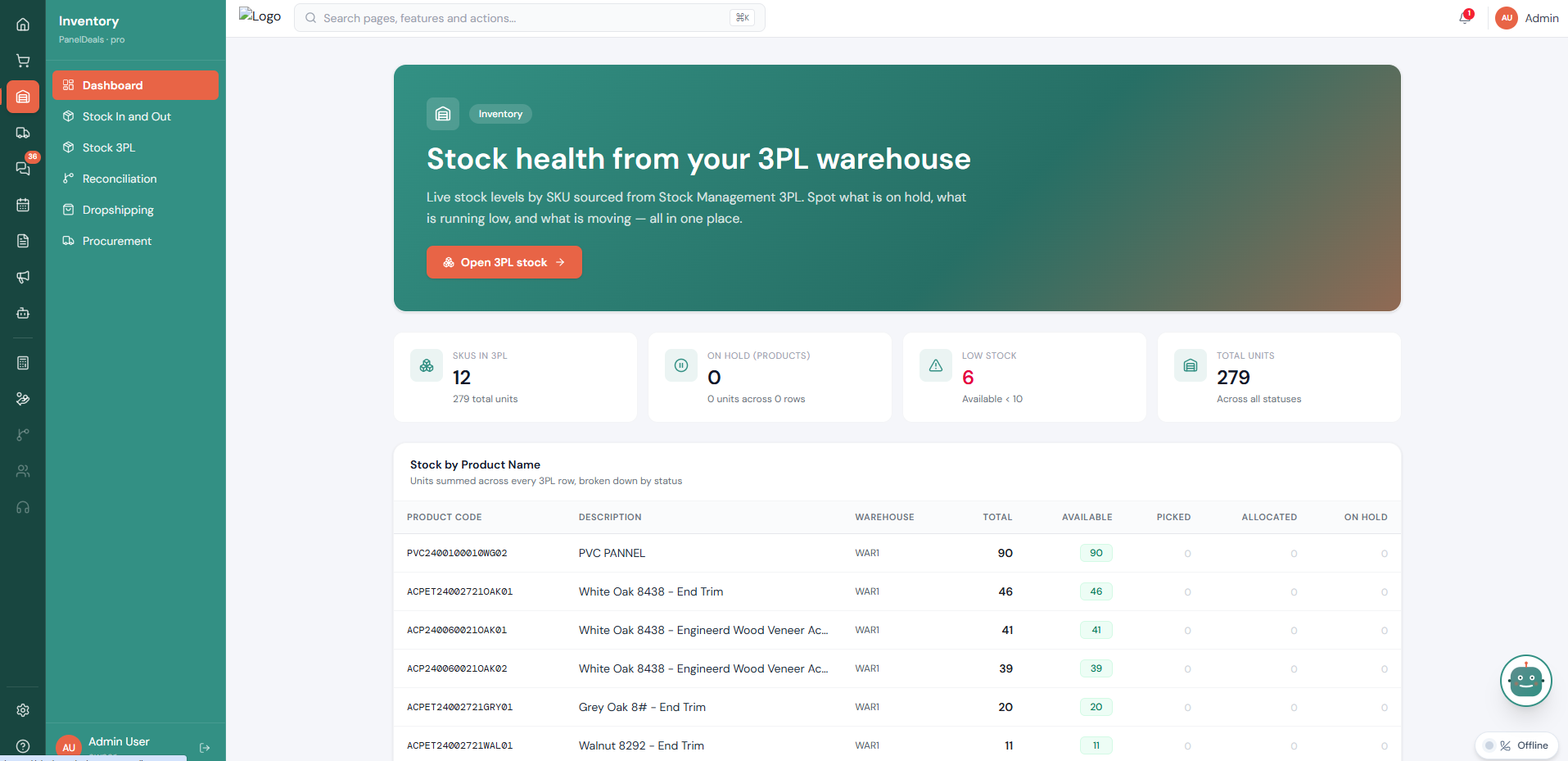
Human approval for supplier, spending and stock decisions whenever you require it.
app.cholaverse.com/inventory
CholaStock inventory workspace
Supplier sourcing Procurement planning Purchase orders Receiving & storage Sales reservations Automated replenishment
End-to-end inventory execution

Inventory isn't a stock number. It's a chain of decisions.

A traditional system tells you 500 units are in stock. It may not tell you that 320 are already reserved, 60 are damaged, one warehouse is about to run out while another sits on excess, a supplier delivery is late, and a campaign next week will spike demand. CholaStock brings every supply and demand signal into one operating view — and its agents continuously understand what's available, what's committed, what's arriving and what should happen next.

01
Plan
02
Source
03
Purchase
04
Receive
05
Store
06
Reserve
07
Balance
08
Replenish
One connected inventory lifecycle

Manage every unit from sourcing to customer order.

01
Plan
Understand confirmed bookings, open orders, forecast demand, availability, inbound supply and safety-stock needs.
02
Source
Compare approved suppliers by price, lead time, minimum order quantity, availability, reliability and terms.
03
Purchase
Create purchase recommendations and orders from demand, available stock, commitments and supplier constraints.
04
Receive
Track expected deliveries, receive products, record discrepancies and update stock as goods arrive.
05
Store
Place stock into the right warehouse, zone or location; keep available, reserved, damaged and quarantined visible.
06
Reserve
Allocate stock to confirmed sales bookings so the same unit can\u2019t be promised to two customers.
07
Balance
Move stock between locations when one has excess inventory and another faces a shortage.
08
Replenish
Order the right quantity early enough to meet future demand without creating unnecessary overstock.
See an inventory agent work

Watch CholaStock prevent a shortage before it happens.

INVENTORY SITUATION · A POPULAR PRODUCT
420
units on hand
280
reserved for bookings
260
forecast to sell / 30 days
96
on open purchase order
120
required safety stock
One warehouse has enough stock — but another location is expected to run out within six days.
01
Detect the risk
The agent combines current stock, sales reservations, recent order velocity, forecast demand and open POs — and sees the business falling below safety stock before the next replenishment cycle.
Agent finding
Projected available stock falls below zero once confirmed bookings and forecast demand are fulfilled.
02
Check sales commitments
It identifies which units are already committed to customers and which remain available, checking required delivery dates, priorities and whether any bookings can ship from another location.
Position
Available now: 140 · Reserved: 280 · Confirmed inbound: 96 · Projected position: below required safety level.
03
Rebalance existing stock
Before buying more, the agent checks whether stock can move from a location with excess cover, and proposes an internal transfer to protect the location facing the immediate shortage.
Recommended transfer
Move 48 units from the central warehouse to the northern fulfilment location.
04
Compare suppliers
It reviews approved suppliers on price, lead time, MOQ, pack size, reliability, terms and past quality. One is cheapest but can\u2019t deliver in time; another costs slightly more but protects the customer commitment.
05
Calculate the purchase quantity
Forecast demand over lead time + confirmed bookings + safety stock − available unreserved stock − confirmed inbound — then adjusted for MOQ, case pack, capacity and budget.
Purchase recommendation
Order 240 units from the supplier able to meet the required delivery date.
06
Apply purchasing controls
The order is within approved product, supplier and quantity rules but exceeds the agent\u2019s autonomous spend limit, so it routes to the procurement manager with the calculation, supplier comparison and shortage risk attached.
07
Track the delivery
Once approved, it issues or records the PO and monitors acknowledgement, dispatch and delivery. If the supplier reports a delay, it recalculates the position and recommends an alternative, partial shipment or extra transfer.
08
Receive and reconcile
On arrival, the warehouse records the quantity received. The agent compares it with the PO, flags shortages or damage, and only updates available inventory once the stock is accepted.
09
Learn from the outcome
Actual demand, supplier performance and delivery timing are recorded — improving future lead-time assumptions, safety-stock recommendations and purchasing decisions.

One inventory risk. One accountable agent. No last-minute stockout.

One connected system

Everything needed to manage supply, stock and sales demand.

P
Procurement planning
Turns bookings, demand, availability, inbound supply and lead times into what to buy, how much and when.
S
Supplier sourcing
Compares suppliers on price, availability, lead time, MOQ, pack size, terms, performance and landed cost.
$
Purchase-order automation
Draft → approve → issue → acknowledge → receive → close, with exceptions escalated by value or risk.
R
Inbound & receiving
Track what\u2019s arriving and when; receive against the PO and make shortages or damage visible instantly.
M
Multi-location inventory
One network view across warehouses, shops and fulfilment partners — total and per-location availability.
A
Reservations & ATP
Confirmed bookings reserve stock; available-to-promise reflects real commitments and inbound supply.
B
Stock balancing & transfers
Move stock before buying more; track every unit through in-transit so availability stays accurate.
~
Intelligent replenishment
Beyond reorder points — decisions from commitments, future demand and supply constraints.
F
Demand forecasting
Combines confirmed demand with historical patterns, seasonality, campaigns and launches.
A truer picture than one on-hand number

Available = on-hand − reserved − blocked.

Available
Physically present and not reserved, blocked or unavailable.
Reserved
Committed to a confirmed sales booking or internal requirement.
Incoming
Expected from approved purchase orders or transfers.
Damaged
Not available for normal sale.
Quarantined
Awaiting inspection or a decision.
In transfer
Moving between locations; held out of both balances.
Returned
Back from a customer, not yet approved for resale.
Available-to-promise
What can be promised by a future date after commitments.
Connected operations

Inventory joined to sales, marketing, fulfilment and finance.

Connected to sales
Confirmed bookings reserve stock; sales teams see what\u2019s available now, what can be promised later and what needs procurement.
Connected to marketing
Before promoting, agents check availability, coverage and fulfilment risk — and excess stock can feed a campaign.
Connected to fulfilment
Warehouses get accurate pick information; picking, packing, shipping and returns flow back into available stock.
Connected to accounting
Approved POs, receipts, landed costs and adjustments give finance the operational context behind the numbers.
Your process, your level of control

Let agents recommend, prepare or execute.

Apply different autonomy levels to different products, suppliers, warehouses and purchasing values.

Assist mode
The agent detects risks, forecasts, compares suppliers and prepares recommendations. Your team completes every purchase, transfer and adjustment.
Approval mode
The agent creates routine purchase orders, replenishment plans and transfers — completed after the right person approves them.
Agent-led mode
The agent executes approved workflows within your supplier, product, quantity, value and risk limits. Anything outside policy is escalated.
Inventory use cases

Built for real supply operations.

Routine replenishment
Monitor stock positions and prepare POs before products reach a critical level.
Sales-booking protection
Reserve stock for confirmed requirements and prevent double-promising the same quantity.
Multi-warehouse balancing
Transfer stock from locations with excess to those facing shortages.
Seasonal purchasing
Plan procurement around seasonal demand, supplier lead time and available storage.
Wholesale & B2B orders
Allocate stock to larger confirmed bookings and flag where more procurement is needed.
Supplier delay management
Identify bookings hit by a delayed shipment and recommend alternative supply.
Excess-stock reduction
Detect overstock and coordinate purchasing, transfer, marketing or supplier returns.
Inventory reconciliation
Compare physical with system stock and investigate unexplained variances.
Inventory analytics

Measure availability, efficiency and supply performance.

Stock availability
Order fill rate
Stockout rate
Inventory turnover
Days of cover
Forecast accuracy
Inventory accuracy
Supplier on-time delivery
Purchase-price variance
Working capital in inventory
How it works

Put your inventory operation into one connected system.

01
Connect supply and demand
Product records, sales channels, bookings, warehouses, suppliers, open POs and relevant financial information.
02
Define the inventory policy
Safety stock, reorder rules, supplier preferences, MOQs, storage limits, approval thresholds and allocation priorities.
03
Begin with supervised recommendations
The agent surfaces shortages, excess, supplier risk and purchase requirements; your team reviews and approves.
04
Automate proven workflows
Let routine POs, transfers and updates run within your limits, with exceptions escalated and every outcome recorded.
Source-to-sale inventory operations

Keep stock available without overbuying.

Give every product an AI inventory agent that knows what's available, what's committed, what's arriving and what needs to happen next.

Put an inventory agent to work Book a demonstration
Start with purchasing recommendations. Increase autonomy as confidence grows.

Frequently asked questions

What does CholaStock manage?

It connects supplier sourcing, procurement planning, purchase orders, inbound deliveries, warehouse storage, sales reservations, stock transfers, replenishment and reconciliation. Exact workflows depend on the integrations enabled for your organisation.

How is inventory linked to sales bookings?

When a booking is confirmed, the required quantity is reserved against the relevant product and location and deducted from what remains available — helping prevent the same stock being committed to another customer.

How does it decide when to order more?

The replenishment calculation considers confirmed bookings, forecast demand, available stock, open POs, safety stock and lead time — then adjusts for MOQ, pack size, budget and storage capacity.

Can an agent create purchase orders automatically?

POs can be prepared automatically when stock is projected below the required level. You control whether the agent only recommends, prepares for approval, or issues within approved limits.

Can it compare multiple suppliers?

Yes — on price, availability, lead time, MOQ, delivery history, payment terms and more. The recommended supplier comes with an explanation of why it was selected.

Can it manage multiple warehouses?

It tracks stock across locations and can identify whether an internal transfer would solve a shortage before recommending an external purchase.

How does it prevent overselling?

Available quantity is calculated after deducting reserved or unavailable stock. When connected channels use the same position, a new reservation reduces what remains available everywhere.

What if a supplier delivery is late?

The agent recalculates the future position, identifies affected bookings, and recommends a transfer, alternative supplier, split shipment, substitute product or revised promise date.

Can it handle damaged or quarantined stock?

Inventory is separated by status, so damaged, quarantined or returned products are excluded from normal sales availability until a decision is made.

Can we require approval for every purchase?

Yes — start with every recommendation and order reviewed by a person, then introduce limits later for established products, approved suppliers and routine order values.

CholaVerse

The AI-native business operator. Your people set the direction; AI agents work alongside them to execute.

20–22 Wenlock Road,
London, N1 7GU, UK
Facebook LinkedIn YouTube X Instagram
XOPS
Sales Operations Customer Service Marketing Finance Human Resources Business Intelligence
PRODUCTS
CholaFlow · CRM CholaStock · Inventory CholaShip · Shipping CholaConnect · Communication CholaPlanner · Tasks CholaDrive · Storage CholaGrowth · Marketing CholaBooks · Finance CholaPeople · HR Compare
INDUSTRIES
E-commerce Retail Logistics Healthcare Hospitality Insurance Brokers All industries →
COMPANY
About CholaVerse Become a partner Affiliate programme Pricing Contact
RESOURCES
Why XOPS? Learn & guides Implementation Department guide Help centre Blog
POLICIES
Terms & conditions Privacy policy Sitemap
© 2026 CholaVerse. All rights reserved.
Privacy Policy | Terms | Contact | Blog | Sitemap